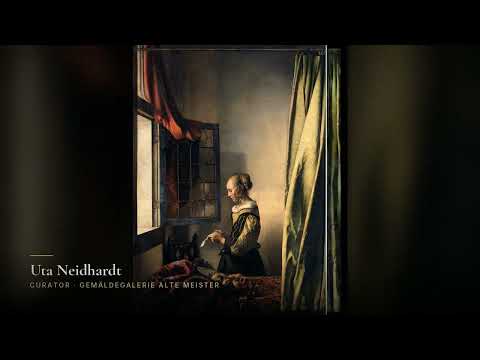
The Cupid Hidden in Vermeer's Girl Reading a Letter
For more than 250 years, Vermeer's letter reader stood before a bare wall. A restoration in Dresden showed that the wall once held a painting of Cupid, and that Vermeer was not the one who covered it.
Girl Reading a Letter at an Open Window was long admired for its stillness and empty background. The empty background turned out not to be Vermeer's.
A quiet picture with a long history
Vermeer painted the work around 1657–1659 in oil on canvas;1 it measures 83 × 64.5 cm.2 It has been in Dresden since 1742,3 when it was bought for the Saxon collection as a work by Rembrandt; it was later given to Pieter de Hooch before being recognised as a Vermeer.2
What the X-rays showed
An X-ray in 1979 and infrared reflectography in 2009 revealed a picture of Cupid under the plain wall behind the girl.1 For decades it was assumed that Vermeer himself had painted it over.1
The restoration that began in 2017, led by the restorer Christoph Schölzel, changed that view: laboratory tests showed that the Cupid had been overpainted decades after it was finished, long after Vermeer's death.3
Removing the overpaint
Between the Cupid and the overpaint, tests found a layer of binding agent and a layer of dirt, a sign that time had passed between them. The overpaint was then removed with a scalpel under a microscope.1
A painting within a painting
The Cupid is a picture within the picture, hanging on the wall behind the reader. A similar Cupid appears in Vermeer's A Young Woman Standing at a Virginal in the National Gallery, London, and the 1676 inventory of his widow's belongings lists a Cupid.3 The restored painting was first shown in Dresden in the exhibition Johannes Vermeer: On Reflection, from 10 September 2021 to 2 January 2022.1
Our video tells the story of the hidden Cupid in English.
Sources
- 1First look at 'new' Vermeer painting as whole hidden Cupid is finally revealed. The Art Newspaper, 2021
- 2Girl Reading a Letter at an Open Window. Wikipedia
- 3Hidden Cupid resurfaces in one of Vermeer's best-known works after two and a half centuries. The Art Newspaper, 2019